
AI vs Manual Documentation: When to Use Which?
As your software grows more complex, the need for clear, accurate, and up-to-date documentation becomes unavoidable. In this edge of AI, you have two main approaches to documentation: manual, human-written documentation, or AI-assisted documentation.
In this article, we’ll take a quick dive into the difference between AI and manual documentation, and explore when to use AI-generated documentation and when manual documentation is the better choice.
Let’s get started.
Why Use AI Documentation?
AI-powered documentation tools like dev-doc come with features like generative writing assistants, context-aware content builders, and generative writing assistants. This transformed the way teams produce and maintain documentation.
Let’s take a quick dive into a few reasons to use AI documentation:
Rapid Content Generation
AI-based documentation tools (e.g., sev-doc) allow developers and technical writers to skip the blank-page stage, quickly generating:
- First drafts of feature descriptions.
- Step-by-step guides based on code.
- API references extracted from schemas.
- Repetitive sections like parameter definitions.
Continuous Updates
If you’re contributing to a SAAS plaform that changes frequently, AI documentation can:
- Detect code changes
- Suggest doc updates
- Flag outdated pages
- Autogenerate version notes
This reduces the backlog caused by rapid feature releases.
Standardization and Formatting
For large teams, AI helps to maintain a unified documentation tone, enforcing structure automatically. This ensures,
- Consistent tone
- Uniform formatting
- Standard templates
- Reusable terminology
Saves time and always stays in sync
AI saves a significant amount of time when creating or updating documentation. With tools like Dev-Doc, your documentation is automatically updated based on code changes. This ensures your documentation stays in sync with your code and can be updated as often as needed.
Use AI-powered documentation when:
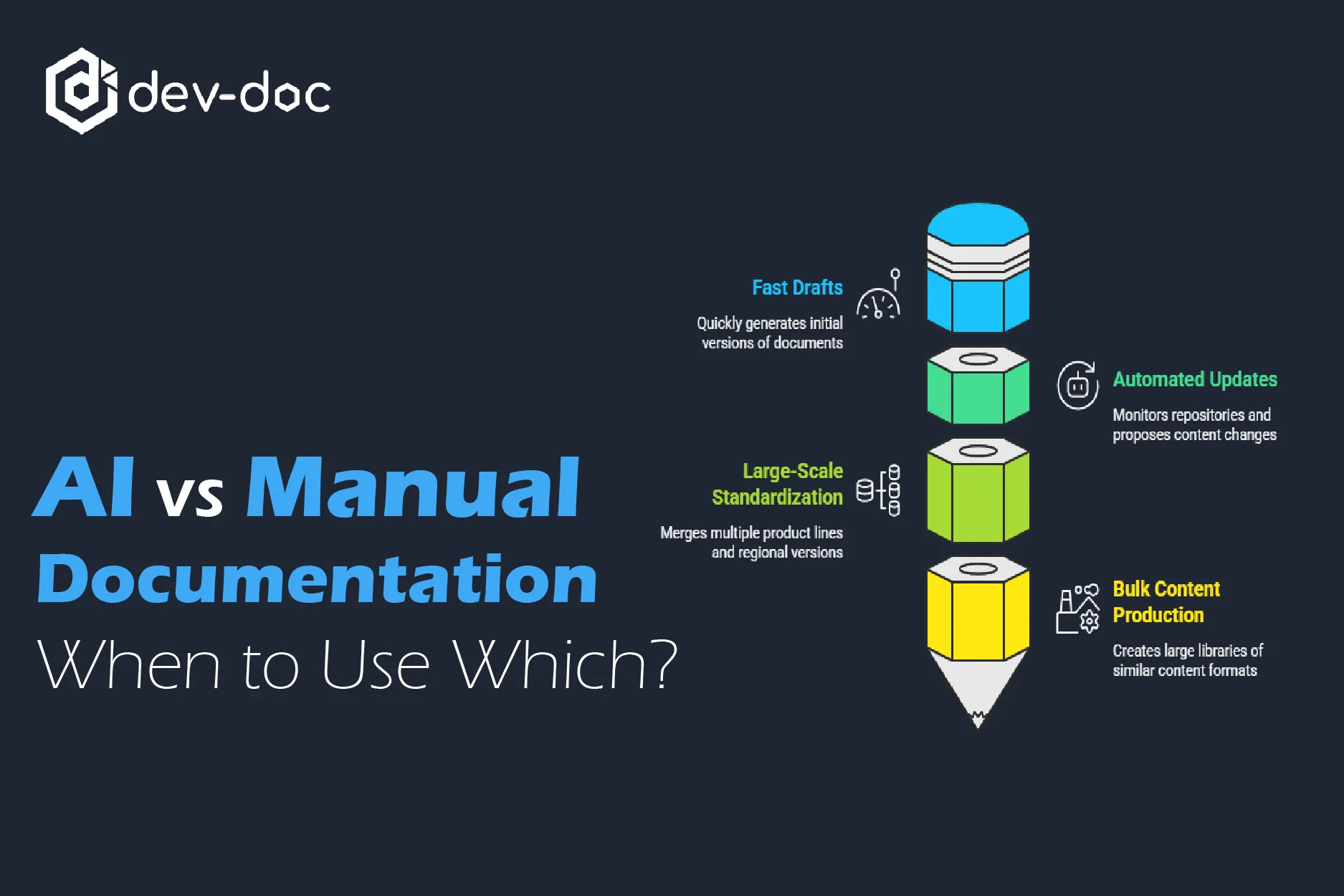
- You need to generate initial versions of guides, FAQs, release notes, and API reference sections.
- You need to monitor repositories and update documentation automatically.
- You marging multiple product lines, regional version, and API endpoints.
- You are handling large libraries of similar content formats.
Manual Documentation is Still Essential
Human-written documentation still plays a crucial role in ensuring domain expertise, accuracy, and user empathy. Here are a few reasons why manual documentation remains essential.
Complex, Nuanced Explanations
Complex topics like Architectural decisions, Design principles, Security considerations, and Real-world scenarious that require deep contextual understanding. These can’t be handled perfectly with AI and require human reasoning and storytelling skills.
Judgment-Based Content
Of course, AI can generate technically correct content, but it often misses the question “Why does it matter?” Manual writing is a better choice when your team prioritizes user-relevant details, analytical insights, and strategic communication. When the project involves multiple personas (Both technical and non-technical), it’s better to utilize human involvement for the documentation.
Tone, Empathy, and User Trust
Users don’t like documentation that feels robotic, especially when the documentation type is one of the following:
- Troubleshooting guides
- Getting-started tutorials
- Onboarding explanations
- Customer education resources
Empathy, reassurance, and structured guidance are best delivered by people.
Use AI powered documenation when:
- You need to explain complex architecture, breaking down the technical workflow in relatable terms.
- Your content needs user empathy, such as examples, narratives, and onboarding journeys.
- You need to ensure accuracy. For example, security, compliance, and configuration guides must be validated by experts.
- You need to create strategic documentation that requires depth and authority (ex., Whitepapers, best practices, and conceptual guides)
Final Thoughts
Modern software developer teams benefit from both AI and manual methods, where AI handles drafting, updating, formatting, and repetitive content. Human handles reviewing, refining technical depth, and ensuring accuracy.
This hybrid approach results in documentation that is faster to produce, easier to maintain, more accurate, clearer, and more user-friendly.
You can consider AI as a powerful accelerator, not a replacement. However, it’s important to understand when to use AI and when to use Human expertise.
AI-powered tools like Dev-doc elevate the overall documentation process, making it easier to create, maintain, and update documentation that stays in sync with your project progress.
If you still have any questions or require any additional support. Feel free to contact us anytime.